


How to Tell if a Leak Is Coming from Your Florida Roof Failing

A ceiling stain doesn’t always mean your roof is done for. In Florida, though, it’s smart to take water seriously. Heavy rain, wind-driven storms, humid air, UV exposure, and hurricane season all make small roof weaknesses show up fast.
The tricky part is that water doesn’t always drip straight down from the problem area. It can enter at a worn boot around a vent pipe, travel along a rafter, soak insulation, and finally stain a ceiling 10 feet away. That’s why guessing costs people money.
The goal is simple: figure out whether the water is coming from the roof system, another part of the house, or a one-time storm issue before the damage spreads.

Start with what the leak is doing inside the house
The first clues are usually indoors. Before climbing, calling someone, or cutting drywall, look at when and where the water shows up.
A true roof-related leak often follows a weather pattern. If the ceiling stain gets darker after hard rain, or you only see dripping during wind-blown storms, the roof system jumps higher on the suspect list.
That said, don’t assume every ceiling stain means roof failure. In Florida homes, water can also come from:
A sweating or clogged air conditioning drain line
A plumbing pipe in the attic or wall
A leaking upstairs bathroom
A window or stucco crack
Condensation around poorly insulated ductwork
A bathroom exhaust fan vented into the attic
A roof leak normally leaves a trail that connects to rain. Plumbing leaks often continue even when the weather is dry. Air conditioning leaks may show up more during hot, humid days when the system runs for hours.
Watch the timing
The timing of the leak tells you a lot.
If water appears only during or shortly after rain, especially heavy rain, the roof, flashing, skylight, chimney area, or roof vent is a likely source. If the stain grows during dry weather, think plumbing or HVAC first.
Wind matters too. The National Weather Service often warns about wind-driven rain during tropical systems and strong thunderstorms because rain doesn’t fall straight down in those conditions. It can push under flashing, lift into vents, or enter beneath damaged shingles.
So if the leak only happens during storms from one direction, that’s a real clue. For example, a ceiling stain on the east side of a Jacksonville home that appears after nor’easter-style wind and rain may point to a vulnerable roof-to-wall area, sidewall flashing, or worn shingles on that roof slope.
Look at the shape of the stain
Water stains can be surprisingly useful.
A roof leak often creates:
Brown or yellow rings on drywall
A stain that expands after rain
Peeling ceiling paint
Bubbling drywall tape
Damp insulation above the stain
A musty smell in one part of the house
A long, straight stain may follow a ceiling joist. A round spot near an exhaust fan may point to a vent or duct issue. A stain near an exterior wall could come from the roof edge, soffit, window, or wall flashing.
If the stain appears around a fireplace, skylight, or vent, don’t ignore the flashing. Flashing is the thin metal or waterproof transition material that seals roof edges, penetrations, and intersections. A lot of leaks start there, not in the wide-open field of shingles.
Check for active moisture without making things worse
If the ceiling is actively dripping, protect the room first.
Move furniture, set out a bucket, and take photos. If the ceiling is bulging, don’t stand directly under it. A water-filled ceiling bubble can release all at once.
If you can safely access the attic, use a flashlight. Don’t step on drywall or insulation. Step only on properly supported framing or walk boards.
Inside the attic, look for:
Wet roof decking
Dark stains on rafters
Water trails on nails
Drips around vent pipes
Damp insulation
Rusted nail tips
Mold-like growth on wood surfaces
The Environmental Protection Agency says wet building materials should be dried quickly, often within 24 to 48 hours, to reduce the chance of mold growth. That doesn’t mean every leak creates a mold problem overnight, but it does mean waiting weeks is a bad plan in Florida’s humidity.
Know the Florida roof conditions that make leaks more likely
Florida roofs age under rough conditions. Jacksonville gets hot sun, high humidity, salty coastal air in some areas, and severe thunderstorms. During hurricane season, roofs can take repeated hits from rain, wind, and debris.
Roofing materials can last a long time when installed well and maintained, but Florida’s climate speeds up wear compared with cooler, drier areas.
Heat and UV light dry out roofing materials
Sunlight is hard on roofs. UV exposure can dry out asphalt shingles, sealants, pipe boots, and coatings. Over time, materials lose flexibility.
When shingles get brittle, they crack more easily. When sealant dries out, small gaps open around penetrations. When rubber pipe boots age, they can split at the base of the vent pipe.
That tiny split may not leak during a light shower. Then a summer storm dumps rain for 30 minutes, and suddenly there’s a stain in the bathroom ceiling.
Wind can lift shingles and loosen flashing
Florida storms don’t need to become hurricanes to damage a roof. Strong thunderstorm gusts can lift shingles, break seals, shift ridge caps, or loosen flashing.
Once a shingle seal breaks, the roof may still look mostly fine from the ground. But during wind-driven rain, water can work uphill under the lifted edge. That’s one reason some leaks only appear during hard storms.
The Florida Building Code includes wind-resistance requirements for roofing because wind is such a major risk in the state. Older roofs, poorly repaired roofs, and roofs with previous storm damage may not perform as well as newer, code-compliant systems.
Humidity hides slow leaks
In dry climates, a small leak might dry quickly. In Florida, moisture can linger. Attics often run hot and humid, and damp insulation can hold water like a sponge.
That can make leak detection harder. You may not see dripping. Instead, you notice:
A musty smell
Higher indoor humidity
Staining that slowly darkens
Paint that won’t stay flat
Soft drywall near the ceiling line
A slow leak can damage decking before the living space shows obvious signs. That’s why attic checks matter after major storms.
Check the most common roof failure points
Roofs rarely fail evenly. Most leaks start at weak points where water has a chance to enter.
Think of the roof as a system. Shingles shed water, but they aren’t the only defense. Underlayment, flashing, drip edge, fasteners, sealants, vents, decking, and drainage all matter.
Pipe boots and roof vents
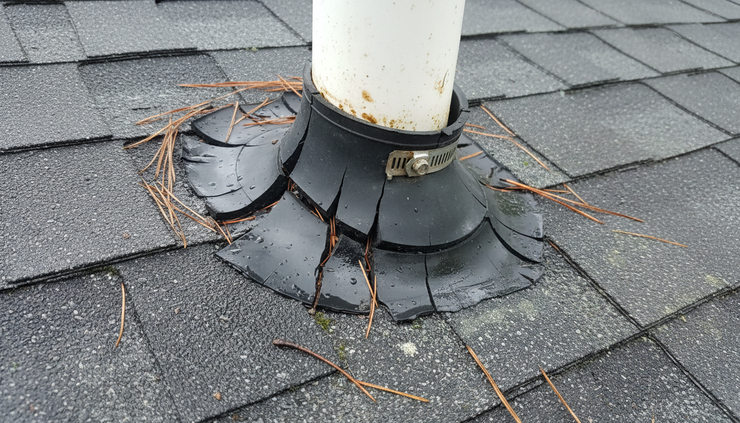
Pipe boots are one of the most common leak points. These are the flashing pieces around plumbing vent pipes that come through the roof.
In Florida heat, rubber boots can crack. Sealant can shrink. Fasteners can back out. When that happens, water can run down the pipe into the attic and show up as a ceiling stain near a bathroom, laundry room, or kitchen.
Signs that a pipe boot may be leaking include:
Staining around a bathroom ceiling
Water trails on the attic side of a vent pipe
Cracked rubber around the pipe
Rusted nails near the boot
Loose shingles around the penetration
From the ground, pipe boot damage may be hard to see. Binoculars can help, but an attic inspection often gives better clues.
Flashing at walls, chimneys, and skylights
Flashing is supposed to direct water away from transitions. If it’s bent, rusted, missing, poorly installed, or buried under too much sealant, it can leak.
Wall flashing is especially important where a roof meets a vertical wall. Chimneys and skylights are also high-risk areas because they interrupt the roof surface.
A leak near a skylight doesn’t always mean the skylight itself failed. The problem may be the flashing around it. The same goes for chimneys. Water can enter around the base, through cracked masonry, or through a missing cricket on wider chimneys.
Watch for:
Stains below skylights
Damp drywall near a chimney
Water marks on attic framing near a sidewall
Sealant that looks cracked or separated
Rusted flashing edges
Avoid the quick-fix trap here. Smearing more sealant over a bad flashing detail may slow water for a while, but it doesn’t correct the water path. A proper repair redirects water, not just covers a gap.
Valleys and low-slope areas
Roof valleys carry a lot of water. During Florida downpours, valleys can move a surprisingly large volume in a short time.
If leaves, pine needles, or shingle granules collect in a valley, water may slow down or back up. If valley flashing is damaged, poorly lapped, or worn, leaks can follow.
Low-slope roof sections deserve extra attention too. Shingles are designed to shed water, not hold standing water. If a low-slope area was covered with the wrong material, water can push into seams more easily.
Common clues include:
Stains below a valley line
Debris piled in one roof channel
Worn shingles in a valley
Dark streaks where water runs heavily
Recurring leaks during intense rain
Jacksonville homes with overhanging trees often deal with leaf buildup. That doesn’t mean trees are bad, but it does mean gutters, valleys, and roof edges need regular attention.
Gutters, drip edge, and fascia
A clogged gutter can make a roof leak look worse than it is, or create a leak at the edge.
When gutters overflow, water can back up under the roof edge, soak fascia, enter soffits, or stain exterior walls. If there’s no proper drip edge, or if the drip edge is installed poorly, water may curl back toward the wood instead of dropping cleanly into the gutter.
Look for:
Water spilling behind gutters
Rotten fascia boards
Stains on soffits
Peeling exterior paint near roof edges
Dampness at ceiling corners
Gutters pulling away from the house
If the ceiling stain sits near an exterior wall, don’t focus only on the roof field. The edge detail may be the problem.

Separate roof failure from plumbing, HVAC, and wall leaks
The fastest way to waste money is to repair the wrong thing. A good leak diagnosis rules out other sources before blaming the roof.
Here’s a practical way to narrow it down.
If the leak happens during dry weather
A roof failure is less likely if water appears when it hasn’t rained.
Check nearby plumbing fixtures. An upstairs shower, toilet, sink, or refrigerator water line can leak into the ceiling below. Even a small supply line leak can leave a stain that looks like storm damage.
If the stain is below a bathroom, run one fixture at a time and watch for moisture. Flush the toilet. Run the sink. Use the shower. If dripping starts after one fixture runs, you’ve got a plumbing clue.
HVAC is another common Florida culprit. Air conditioners remove moisture from indoor air. That water has to drain somewhere. If the condensate drain clogs, backs up, or overflows, water may stain ceilings or walls.
Signs of an HVAC-related leak include:
Water near the air handler
A stain under attic ductwork
Dripping during hot days, not rainy days
A full emergency drain pan
Damp insulation around ducts
A musty smell near supply vents
Condensation can also form when warm, humid attic air meets cold ducts or poorly insulated metal surfaces. That can mimic a roof problem.
If the leak happens near windows or exterior walls
Water can enter through walls, not just roofing. In Florida storms, rain can hit sideways. That makes windows, doors, stucco cracks, siding joints, and wall penetrations important.
If you see staining around a window head or along a wall, look outside for:
Cracked caulk
Gaps around window trim
Stucco cracks
Missing kick-out flashing
Stains below roof-to-wall intersections
Water running down siding during rain
Kick-out flashing is a small but important piece that directs roof water into the gutter instead of down the wall. When it’s missing, water can soak the wall and show up indoors far from the roof edge.
If the leak appears after extreme wind
Storm damage can be subtle.
After a strong storm, check the ground first. Look for pieces of shingles, roof cement, flashing, or ridge cap. Then look from a safe place with binoculars.
Do not climb onto a wet roof. Wet shingles are slippery, and tile or metal roofs can be especially dangerous.
From the ground, look for:
Missing shingles
Lifted or curled shingle edges
Exposed underlayment
Bent vents
Damaged ridge caps
Branch impacts
Granules washed into downspouts
Granule loss matters because granules help protect asphalt shingles from UV exposure. Some granule shedding is normal, especially on newer roofs, but heavy bare spots or piles after a storm deserve attention.
This is also where documentation helps. Take clear photos of stains, attic water trails, exterior damage, and any debris. If you end up working with insurance, a licensed contractor, or a home inspector, those photos give everyone a baseline.
More likely roof-related
Water appears during rain, stains grow after storms, attic decking is wet, nearby roof penetrations show damage, leak happens during wind-driven rain.
More likely non-roof-related
Water appears in dry weather, stain sits below a bathroom, HVAC drain pan is wet, cold ductwork is sweating, leak follows fixture use.
Decide whether the roof is failing or just needs a repair
Not every leak means the entire roof has failed. A cracked pipe boot, a loose vent, or one small flashing issue may be repairable.
But some signs point to a bigger roof system problem.
Signs a targeted repair may be enough
A focused repair may be reasonable when:
The roof is otherwise in good condition
Damage is limited to one penetration
Shingles around the area are still flexible and intact
Decking is not soft or rotten
The leak source is clear
The same area hasn’t been repaired several times
For example, a single cracked vent boot on a newer roof usually doesn’t mean the whole roof is failing. A proper repair may solve the issue.
Signs the roof system may be failing
A failing roof tends to show patterns, not just one bad spot.
Look for:
Multiple leaks in different rooms
Widespread missing or lifted shingles
Brittle, cracked, or curled shingles
Large bare patches where granules are gone
Sagging roof decking
Soft spots along the roof surface
Repeated leaks after past repairs
Dark attic stains across several areas
Daylight visible through roof boards
Rotten fascia or decking at multiple edges
If the roof has several weak points, patching one area may only buy a little time. Water will find the next path.
Age matters, but condition matters more. Two roofs installed in the same year can age differently based on ventilation, material quality, installation, sun exposure, tree cover, storm history, and maintenance.
Why attic ventilation affects leak symptoms
Ventilation doesn’t usually create a rain leak by itself, but poor attic airflow can make moisture problems worse.
Florida attics get extremely hot. If warm, moist air stays trapped, it can contribute to condensation, wood staining, and shingle stress. Proper intake and exhaust ventilation help manage heat and moisture.
A badly ventilated attic may show signs that look leak-related:
Rusted nail tips
Damp wood surfaces
Musty odor
Dark staining on decking
Condensation on metal parts
That’s why a careful inspection looks at both water entry and moisture movement inside the attic.

What to do next if you suspect the roof is the source
Once you’ve gathered clues, act in the right order. The wrong move can make damage worse or put you in danger.
Protect the house first
If water is active, limit the damage.
Move belongings away from the wet area
Put a bucket or plastic bin under drips
Photograph stains and dripping water
If safe, place a tarp over belongings in the attic, not over electrical equipment
Turn off electricity to affected fixtures if water is near lights or wiring
Run fans or a dehumidifier after the water source is controlled
Don’t paint over the stain until the leak is fixed and the material is dry. Paint can hide the problem while moisture keeps damaging drywall or wood.
Avoid risky roof work
A Florida roof after rain is not a good place for guesswork. Wet shingles, steep slopes, loose granules, and hidden soft spots can all cause falls.
Skip these moves:
Walking on a wet roof
Lifting shingles if you don’t know how they’re installed
Driving random nails into shingles
Coating large areas with sealant
Pressure washing shingles
Cutting attic materials without finding the water path
Sealant has a place in roofing, but it’s not a cure-all. If water is getting behind flashing, under shingles, or through rotten decking, surface sealant may trap moisture instead of solving the leak.
Call for help when the clues point to roof damage
If the leak follows rain, attic evidence points upward, or visible roof components look damaged, it’s time for a professional inspection. A qualified florida roofer can check flashing, penetrations, shingles, underlayment, decking, ventilation, and drainage as one system.
Ask for photos of the problem areas. A good inspection should explain the probable source, the repair options, and whether the issue is isolated or part of a larger roof failure pattern.
If storm damage may be involved, keep your photos, note the date of the storm, and avoid permanent repairs until the damage has been properly documented. Temporary measures are fine when they prevent more water from entering.
Keep a simple leak log
This sounds boring, but it helps.
Write down:
The date and time you noticed water
Whether it was raining
Wind direction if you noticed it
Which room was affected
Photos of the stain
Any attic findings
What changed after the next storm
A pattern over two or three rain events can make diagnosis much clearer.
FAQ
Can a roof leak show up far away from the actual roof damage?
Yes. Water can travel along rafters, roof decking, pipes, insulation, or ceiling joists before it shows up indoors. The ceiling stain may be several feet away from the entry point.
Is a ceiling stain after one storm enough to prove my roof is failing?
No. One stain proves water got in or formed somewhere, but it doesn’t prove total roof failure. The source could be a vent boot, flashing, HVAC drain, plumbing line, or wall leak. The pattern and inspection findings matter.
Why does my leak only happen during heavy wind and rain?
Wind-driven rain can push water under lifted shingles, around flashing, or into vulnerable roof penetrations. Light rain may not hit the weak spot at the right angle or with enough force to enter.
Should I go into the attic during a storm to find the leak?
Only if it’s safe. Don’t touch wet electrical components, don’t step on drywall, and don’t move through an attic without stable footing. It’s often safer to check soon after the storm with a flashlight.
Does homeowners insurance cover roof leaks in Florida?
Coverage depends on the cause, policy terms, roof condition, and timing. Sudden storm damage may be treated differently from wear, neglect, or an old unresolved leak. Document the damage and speak with your insurance professional if you plan to file a claim.
The takeaway
A leak from a Florida roof usually leaves clues. Start with the timing, then check the stain pattern, attic evidence, roof penetrations, flashing, valleys, gutters, and nearby plumbing or HVAC systems.
If water shows up after rain, especially wind-driven rain, and the attic or roof exterior shows matching signs, the roof is likely involved. If water appears during dry weather, look harder at plumbing, air conditioning, or condensation.
The big thing is not to guess. Florida moisture can turn a small leak into damaged drywall, insulation, decking, or indoor air issues faster than most people expect. Find the path, document what you see, and get the roof system checked before one stain becomes a much larger repair.


Comments